The Busy Trap…
March 31, 2013
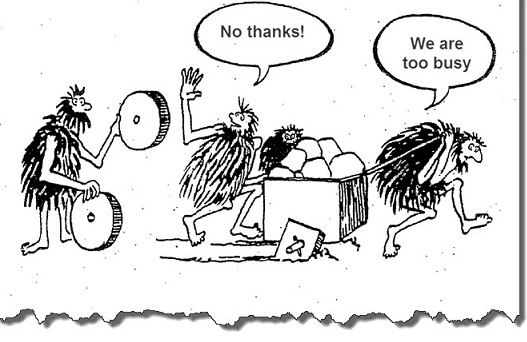
The following text is a June 2012 New York Times blog post by writer-cartoonist Tim Kreider called « The ‘Busy’ Trap »:
« If you live in America in the 21st century you’ve probably had to listen to a lot of people tell you how busy they are. It’s become the default response when you ask anyone how they’re doing: “Busy!” “So busy.” “Crazy busy.” It is, pretty obviously, a boast disguised as a complaint. And the stock response is a kind of congratulation: “That’s a good problem to have,” or “Better than the opposite.”
Notice it isn’t generally people pulling back-to-back shifts in [a hospital’s intensive care unit] or commuting by bus to three minimum-wage jobs who tell you how busy they are; what those people are is not busy but tired. Exhausted. Dead on their feet. It’s almost always people whose lamented busyness is purely self-imposed: work and obligations they’ve taken on voluntarily, classes and activities they’ve “encouraged” their kids to participate in. They’re busy because of their own ambition or drive or anxiety, because they’re addicted to busyness and dread what they might have to face in its absence.
Almost everyone I know is busy. They feel anxious and guilty when they aren’t either working or doing something to promote their work. They schedule in time with friends the way students with 4.0 [grade point average] make sure to sign up for community service because it looks good on their college applications. I recently wrote a friend to ask if he wanted to do something this week, and he answered that he didn’t have a lot of time but if something was going on to let him know and maybe he could ditch work for a few hours. I wanted to clarify that my question had not been a preliminary heads-up to some future invitation; this was the invitation. But his busyness was like some vast churning noise through which he was shouting out at me, and I gave up trying to shout back over it.
Even children are busy now, scheduled down to the half-hour with classes and extracurricular activities. They come home at the end of the day as tired as grown-ups. I was a member of the latchkey generation and had three hours of totally unstructured, largely unsupervised time every afternoon, time I used to do everything from surfing the World Book Encyclopedia to making animated films to getting together with friends in the woods to chuck dirt clods directly into one another’s eyes, all of which provided me with important skills and insights that remain valuable to this day. Those free hours became the model for how I wanted to live the rest of my life.
The present hysteria is not a necessary or inevitable condition of life; it’s something we’ve chosen, if only by our acquiescence to it. Not long ago I Skyped with a friend who was driven out of the city by high rent and now has an artist’s residency in a small town in the south of France. She described herself as happy and relaxed for the first time in years. She still gets her work done, but it doesn’t consume her entire day and brain. She says it feels like college — she has a big circle of friends who all go out to the cafe together every night. She has a boyfriend again. (She once ruefully summarized dating in New York: “Everyone’s too busy and everyone thinks they can do better.”) What she had mistakenly assumed was her personality — driven, cranky, anxious and sad — turned out to be a deformative effect of her environment. It’s not as if any of us wants to live like this, any more than any one person wants to be part of a traffic jam or stadium trampling or the hierarchy of cruelty in high school — it’s something we collectively force one another to do.
Busyness serves as a kind of existential reassurance, a hedge against emptiness; obviously your life cannot possibly be silly or trivial or meaningless if you are so busy, completely booked, in demand every hour of the day. I once knew a woman who interned at a magazine where she wasn’t allowed to take lunch hours out, lest she be urgently needed for some reason. This was an entertainment magazine whose raison d’être was [rendered obsolete] when “menu” buttons appeared on [TV remote controls], so it’s hard to see this pretense of indispensability as anything other than a form of institutional self-delusion. More and more people in this country no longer make or do anything tangible; if your job wasn’t performed by a cat or a boa constrictor in a Richard Scarry book I’m not sure I believe it’s necessary. I can’t help but wonder whether all this histrionic exhaustion isn’t a way of covering up the fact that most of what we do doesn’t matter.
I am not busy. I am the laziest ambitious person I know. Like most writers, I feel like a reprobate who does not deserve to live on any day that I do not write, but I also feel that four or five hours is enough to earn my stay on the planet for one more day. On the best ordinary days of my life, I write in the morning, go for a long bike ride and run errands in the afternoon, and in the evening I see friends, read or watch a movie. This, it seems to me, is a sane and pleasant pace for a day. And if you call me up and ask whether I won’t maybe blow off work and check out the new American Wing at the [Metropolitan Museum of Art] or ogle girls in Central Park or just drink chilled pink minty cocktails all day long, I will say, what time?
But just in the last few months, I’ve insidiously started, because of professional obligations, to become busy. For the first time I was able to tell people, with a straight face, that I was “too busy” to do this or that thing they wanted me to do. I could see why people enjoy this complaint; it makes you feel important, sought-after and put-upon. Except that I hate actually being busy. Every morning my in-box was full of e-mails asking me to do things I did not want to do or presenting me with problems that I now had to solve. It got more and more intolerable until finally I fled town to the Undisclosed Location from which I’m writing this.
Here I am largely unmolested by obligations. There is no TV. To check e-mail I have to drive to the library. I go a week at a time without seeing anyone I know. I’ve remembered about buttercups, stink bugs and the stars. I read. And I’m finally getting some real writing done for the first time in months. It’s hard to find anything to say about life without immersing yourself in the world, but it’s also just about impossible to figure out what it might be, or how best to say it, without getting the hell out of it again.
Idleness is not just a vacation, an indulgence or a vice; it is as indispensable to the brain as vitamin D is to the body, and deprived of it we suffer a mental affliction as disfiguring as rickets. The space and quiet that idleness provides is a necessary condition for standing back from life and seeing it whole, for making unexpected connections and waiting for the wild summer lightning strikes of inspiration — it is, paradoxically, necessary to getting any work done. “Idle dreaming is often of the essence of what we do,” wrote Thomas Pynchon in his essay on sloth. Archimedes’ “Eureka” in the bath, Newton’s apple, Jekyll & Hyde and the benzene ring: history is full of stories of inspirations that come in idle moments and dreams. It almost makes you wonder whether loafers, goldbricks and no-accounts aren’t responsible for more of the world’s great ideas, inventions and masterpieces than the hardworking.
“The goal of the future is full unemployment, so we can play. That’s why we have to destroy the present politico-economic system.” This may sound like the pronouncement of some bong-smoking anarchist, but it was actually Arthur C. Clarke, who found time between scuba diving and pinball games to write “Childhood’s End” and think up communications satellites. My old colleague Ted Rall recently wrote a column proposing that we divorce income from work and give each citizen a guaranteed paycheck, which sounds like the kind of lunatic notion that’ll be considered a basic human right in about a century, like abolition, universal suffrage and eight-hour workdays. The Puritans turned work into a virtue, evidently forgetting that God invented it as a punishment.
Perhaps the world would soon slide to ruin if everyone behaved as I do. But I would suggest that an ideal human life lies somewhere between my own defiant indolence and the rest of the world’s endless frenetic hustle. My role is just to be a bad influence, the kid standing outside the classroom window making faces at you at your desk, urging you to just this once make some excuse and get out of there, come outside and play. My own resolute idleness has mostly been a luxury rather than a virtue, but I did make a conscious decision, a long time ago, to choose time over money, since I’ve always understood that the best investment of my limited time on earth was to spend it with people I love. I suppose it’s possible I’ll lie on my deathbed regretting that I didn’t work harder and say everything I had to say, but I think what I’ll really wish is that I could have one more beer with Chris, another long talk with Megan, one last good hard laugh with Boyd. Life is too short to be busy. »
Rape Culture? To rape or be raped…
March 20, 2013
Tired
by sisterarnell
I am tired down to my bones. Tired of trying to explain why I am tired. Tired of fighting all the little things that add up to a mountain and a constant uphill trudge.
This Steubenville rape case is just the last straw. If you haven’t heard the words “rape culture” by now, you must have been ignoring the whole thing, which I probably should have done, but I just couldn’t.
I’m going to soapbox here for a minute.
Rape culture is a society giving women a list of do’s and don’t’s that boil down to “make sure he rapes the other girl.”
Rape culture is a society where women are scared to go out by themselves at night.
Can we think about that for a minute? We’ve created a society where women are scared to be by themselves. Isn’t that horrifying? The ability to be alone, to be yourself, to choose to do whatever you want is limited because of fear.
I’m scared to go camping by myself. Not because of the wild animals, but because of the wild humans who are more terrifying than any bear or cougar. They will just maul you to death and then eat your corpse. It will hurt for a bit, but it will be over quickly, especially if the cougar manages to get the right bite on the back of your skull to sever the spinal column.
No, it’s the humans that do the real damage. It’s the humans that leave scars that last a lifetime. It’s the humans who play with your body and kill your soul. It’s the humans who think they have a right to your body because you chose to walk by yourself home from the library after studying for three hours for that physiology final you have tomorrow. Or because you wore your hair in a ponytail so obviously you want someone to grab you by it and throw you to the ground. Or because you walked by a construction site. Or a dorm. Or down the street in your neighborhood.
It’s the humans who say, “hey, she was drunk.” Who blame a girl, not even a woman, for “bad judgment” because getting intoxicated obviously causes boys to forcibly penetrate you repeatedly, take pictures of it, send them to their friends, laughing about what you did. It’s the humans who excuse this behavior because boys will be boys, and skill at sports washes away any “mistakes.” And then sentences you to less time in prison than you would get for pirating a DVD or possessing cocaine. What does that tell the victim? You are less important to society than a bootleg of Gigli.
Rape is not a mistake. You don’t just fall over and end up with your penis in someone’s vagina or anus. You don’t accidentally rape someone. Rape takes intent. It’s an act of power over someone who you consider less than, non-human, the other. It’s not about sex and boys are horny and it just happens. It’s about perpetrators not thinking their victim is a person.
Stop teaching “boys are boys.” I have a son. He’s a total boy. But he’s not an asshole. Boys don’t have to be assholes. You have to teach them to be assholes. And really, when advertisements feature women selling everything, it creates a culture where the women are just objects that are for sale. The female body is something to be consumed, that is designed to be looked at, that exists to be looked at.
I’m tired of it. I’m tired of a culture that thinks it is okay for you to come talk to me on the subway, and when I am not interested, I’m automatically a bitch or a lesbian. You know what? You don’t have a right to my time or attention any more than you have a right to my body. I do not exist for your ends. I am an end in and of myself and you do not own me. So if I choose to spend time with you, consider yourself lucky, and if I don’t want to spend time with you, that’s not my problem, because I do not have responsibilities to you other than to respect you as a person. And I’ll do that.
And if you bitch to your friends about how the girls never like the nice guy, because they are really selfish shallow status-obsessed bitches who always friendzone you, then you’re not really a nice guy, you’re a misogynist in nice guy clothing.* And if you think for one instant that anything a woman does entitles you to have sex with her other than her explicit consent, you are wrong. Because if you do, then I am going to walk up to you and hit you with a baseball bat. Because you didn’t say no, so that means you are consenting to it.
Unconscious means no.
Wearing a mini skirt means no.
Walking by herself means no.
Hair in a ponytail. NO.
Hair not in a ponytail. NO.
She’s had sex with you before. NO.
She’s had sex with your friends. NO.
She’s never had sex. NO.
She flirted with you. NO.
She drank alcohol. NO.
She did drugs. NO.
I mean, really. You learned no when you were a two year old. How difficult is it to get this through your mind, society? The default of “can I have sex with this woman or man” is no. NO NO NO. Just stop it.
And yes, I know people will say, that focusing on changing the behavior of the rapist is unrealistic. You know what? I don’t care. According to RAINN,almost 2/3rds and 38% of rapes are committed by someone the victim knows. You know what that means? You aren’t safe with your friends. We’ve created a culture that means most people are not safe ever. And nothing about the way I dress is going to change that. So stop telling me that I should spend my life expecting to be raped, because that is wrong. You create that culture by saying it. And then excusing it by blaming the victim. And then creating a culture that is so misogynistic about the treatment of victims that only 3% of rapists actually spend any time in prison.
Women are people. Men are people. Stop raping people.
And, because I’m going to assume that the people reading this are the ones who wouldn’t rape someone, though statistically, who knows, I have some advice for you too.
Stop rape culture. Stop laughing at jokes that objectify and sexualize women. Stop consuming media that sexualizes women. Stop making excuses for men being assholes. Name and shame, people. Name the behavior when you see it. Point out how this perpetuates a culture that promotes a society that makes people into victims, and victims into the cause instead of the effect. I’ve read enough social construction IR theory to know that this works if people are committed to making a change. So put it into action.
Stop rape. Stop rape culture.



 Matters That Matter ®